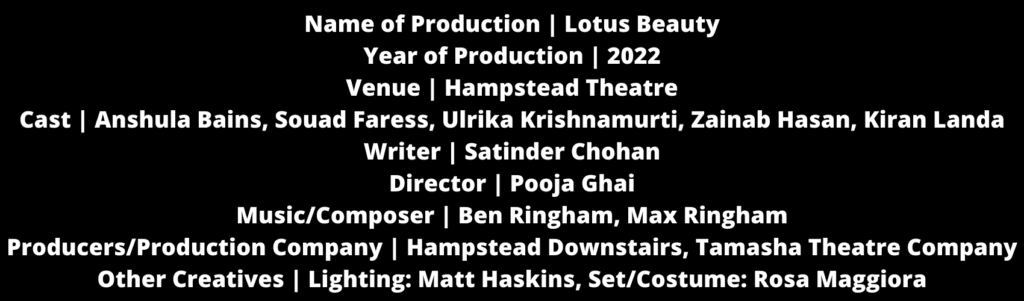
Satinder Chohan’s latest offering presents an all-female cast in this confessional ode to the strength and heritage of South Asian women, juxtaposing and probing their dilemmas, decisions and disappointments with the modern British Asian woman.
The Lotus Beauty salon is prim and proper, much like its self-made Punjabi owner, Reita (Landa). As she opens her salon, she greets her staff and family: Tanwant (Hasan), her facetious underling, eager to land a husband and a house; Kamal (Krishnamurti), her local cleaner, and her impertinent teenage daughter, Pinky (Bain); Reita’s conservative mother-in-law, Big Dhadhi (Faress), also makes an appearance later, providing unsolicited opinions and news of Reita’s former client, Sangita, who was heard to have thrown herself in front of a train. This sparks an intense debate about married life, motherhood, patriarchy, self-hatred, beauty standards, social mobility and domestic abuse within Southall South Asian society.
Lotus Beauty begins and concludes with suicide as the women struggle to acquire economic status, social legitimacy and the escape from oppressive socio-cultural expectations. Pinky strikes a questionable deal with her boyfriend to aid Tanwant in expediting a fake British passport and procuring a sham husband by losing her virginity. Reita’s dream to elevate her family by moving away from Southall to a leafy suburb is halted by her mother-in-law’s resistance to change. Kamal, abused physically and emotionally by her family, absurdly contemplates her own suicide after witnessing Sangita’s death. The womens’ underlying trauma emerges as Big Dhadi recounts undergoing compulsory virginity tests by British officials when she arrived in the UK, and Reita grapples with complicity in her own mother’s suicide.
Director Pooja Ghai and writer Chohan have mastered the art of portraying disappointment and betrayal amongst underestimated women. The lotus flower is a befitting motif, emotionally and culturally compelling as the women thrive in the most brutal environments. Landa, Krishnamurti and Faress’ soul-stirring scenes trigger contemplation and unease amongst the audience. There could have been greater thematic development and resolution with the generational differences and maternal loss that infects Reita’s relationship with Pinky; and Chohan’s writing occasionally feels overwhelmingly ambitious, highlighting multiple heavy themes without fully exploring their nuances. Nevertheless, the characters’ melodrama makes us question and empathise with their actions – and this is a start. Much like barbershop talk, where men bare their souls, the salon (meticulously designed by Rosa Maggiora to become an intimate sanctuary) allows these women to divulge and heal.

Check out more from Hampstead Theatre | Find out more about Satinder Chohan| Pooja Ghai| Tamasha Theatre Company |
| See more Off/Stage Review Bytes on IG |