Amidst the chaos of war, community upheaval and change in 1970s Pittsburgh, the beauty of August Wilson’s fiercely enduring ‘Jitney’ lies in the richness of its characters and contexts, uncovering surprising familiarity within seemingly different people, places and perceptions.
Faced by the imminent closure of his unlicensed (titular) cab station, Becker (Johnson) is pressured by the city’s eagerness to urbanise its inner-city areas. As a notorious peacekeeper, he doesn’t resist the closure, causing conflict amongst his workers. He also faces the return of his son, Booster (Marrett Jr), recently released from prison, charged with the alleged rape and murder of a white woman. Becker’s feisty cab drivers are divided by this intergenerational conflict, magnified by the backdrop of martial disharmony following the Vietnam war and social disillusionment. But Becker’s sudden demise allows the men to discover unparalleled strength in the collective to continue the legacy of his Jitney with Booster taking his father’s torch.
Set in the cab station, the piece could have easily slipped into monotony, but each character is given opportunity to ruminate on their own journeys. The play retains its relevance as gentrification and institutional disregard for minority businesses are still rampant. Wilson’s discourse on black manhood and toxic masculinity does not artificially excuse immoral behaviour but offers a multi-layered understanding of Booster and Becker’s emotional trauma. The elder cab drivers offer diverging perspectives that either violently clash or compliment the youth but are instrumental in their moulding of these young black men. Ultimately, they realise their circumstances are similar in their struggle with dislocation, disconnection and finding solace in each other.
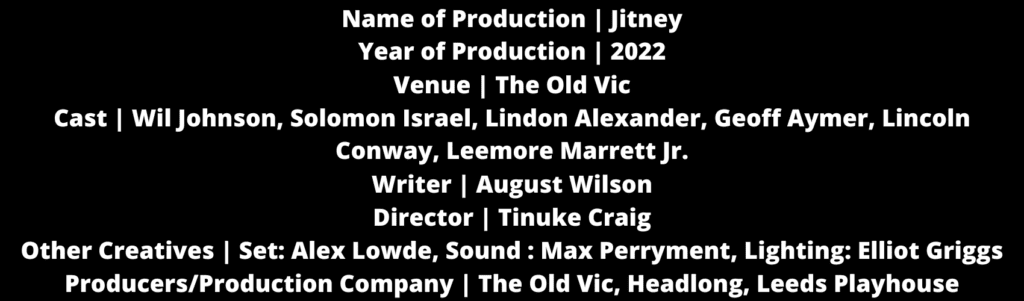
Each scene becomes a vintage portrait of 70s Pittsburgh with Alex Lowde’s innovative stage design with a slanted rectangular frame, reminiscent of a box-like TV set. Elliot Griggs’ experimental lighting design of archive footage of pedestrian life and geographical maps of Pittsburgh’s Hill District is projected onto the perimeter of the rectangular stage frame, and even onto the characters themselves, giving the effect that they are wearing the history they are portraying. Brimming with 70s soul/jazz musical interludes, authentic slang and the era-defining collars and flares, Jitney emerges as an ambitious immersive experience into the era’s black culture and community. The plays dedication to authenticity, flair and engrossing character development shows that staging a classic of this calibre requires an audacious hunger to direct with awareness as Tinuke Craig does here – much like Wilson himself.

Check out more from The Old Vic | Find out more about August Wilson | Leeds Playhouse | Headlong |
| See more Off/Stage Review Bytes on IG |